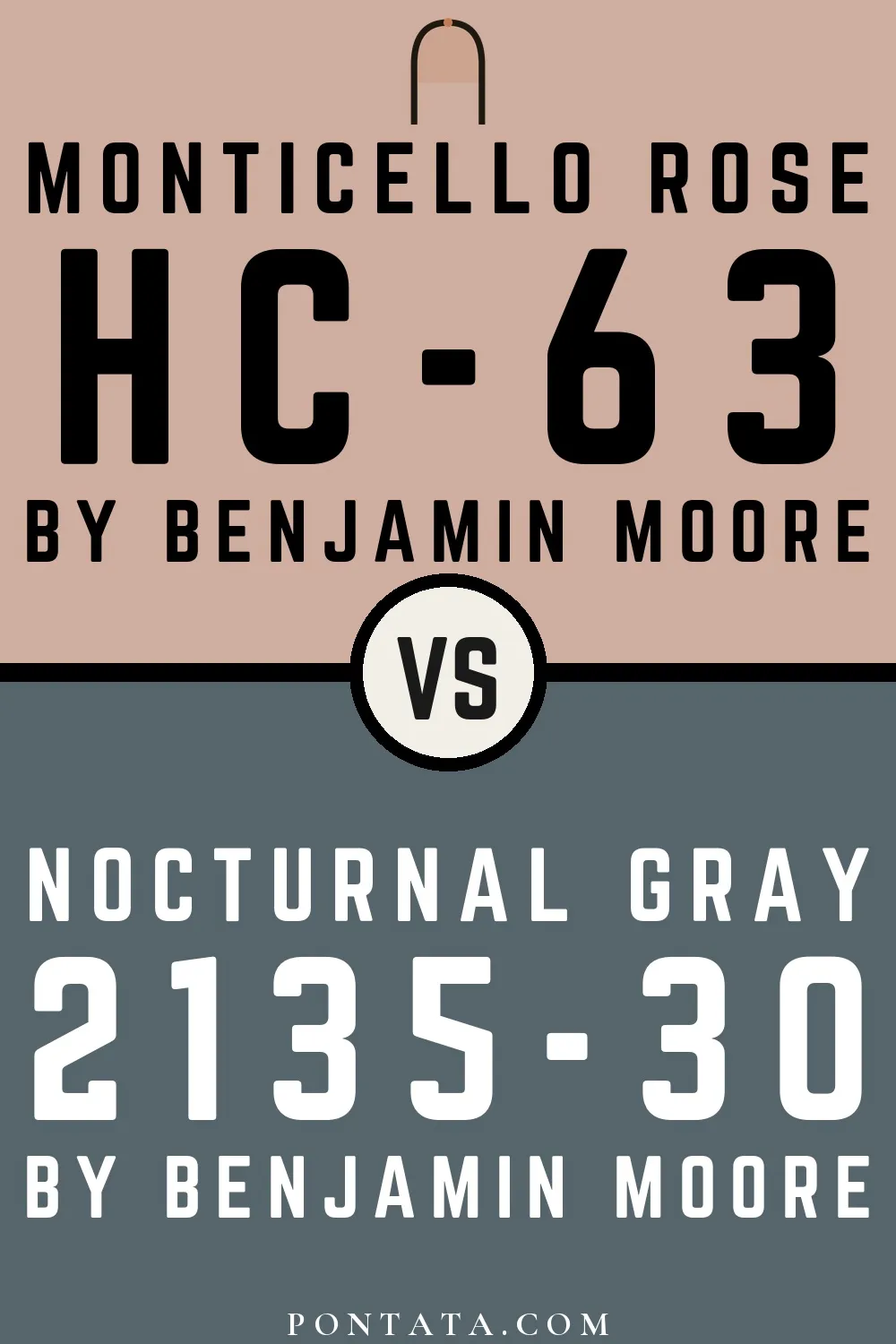
Monticello Rose vs Nocturnal Gray
Both from Benjamin Moore's palette. Hue-wise, Monticello Rose belongs to the beige-pink family and Nocturnal Gray to the blue-grey family. Monticello Rose (LRV 46) reflects noticeably more light than Nocturnal Gray (LRV 14), a difference of 32 points that becomes especially apparent in rooms with limited natural light. Monticello Rose runs red while Nocturnal Gray is decidedly blue, which means they'll respond very differently to warm vs cool light sources. With a ΔE of 39.4, the contrast is hard to miss. These aren't variations on a theme — they're two different answers to the same question. Below you'll find 1 real-room photo comparison where both colors appear side by side, plus 5 simulated room previews.
Monticello Rose vs Nocturnal Gray in Real Spaces
1 real room side by side. Seeing Monticello Rose and Nocturnal Gray in actual rooms makes the difference concrete; browse the spaces below to get a feel for how each color lives on a wall.
Living Room
In a living room, color works across both daylight and evening light — the same wall can read very differently at noon and at 8pm. The LRV gap is large enough that Monticello Rose will make the room feel meaningfully brighter than Nocturnal Gray would.


Color Details
Monticello Rose vs Nocturnal Gray Simulated Comparison
5 simulated room previews — drag the slider on each to see Monticello Rose on one side and Nocturnal Gray on the other.


Digital color is approximate. These simulations are generated from the manufacturer's hex values and overlaid on grayscale room photos — your screen's calibration, brightness, and viewing angle all affect how they render. Before committing to either color, test physical samples in your own space under the light you actually live with.