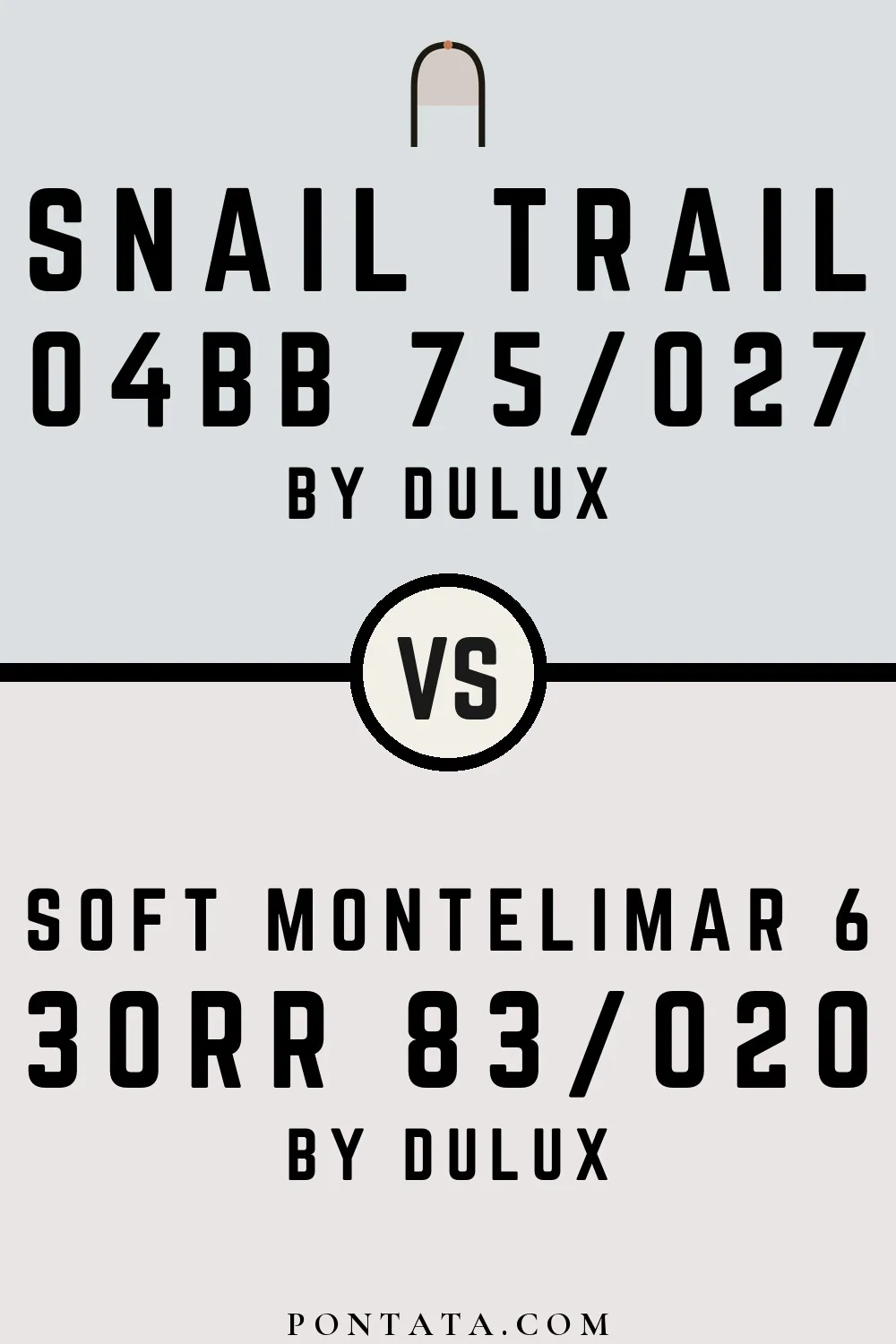
Snail Trail vs Soft Montelimar 6
Both from Dulux's palette. Hue-wise, Snail Trail belongs to the blue-white family and Soft Montelimar 6 to the white family. Soft Montelimar 6 (LRV 83) reflects noticeably more light than Snail Trail (LRV 75), a difference of 8 points that becomes especially apparent in rooms with limited natural light. Snail Trail runs cool while Soft Montelimar 6 is decidedly warm, which means they'll respond very differently to warm vs cool light sources. The ΔE 5.1 gap is real but not dramatic — close enough to use together, distinct enough to matter as a choice. Below you'll find 1 real-room photo comparison where both colors appear side by side, plus 5 simulated room previews.
Snail Trail vs Soft Montelimar 6 in Real Spaces
1 real room side by side. Snail Trail and Soft Montelimar 6 are close enough that the difference can be hard to judge from a chip alone — these photos show how each reads at scale, across different spaces and lighting conditions.
Living Room
In a living room, color works across both daylight and evening light — the same wall can read very differently at noon and at 8pm. The LRV gap is large enough that Soft Montelimar 6 will make the room feel meaningfully brighter than Snail Trail would.


Color Details
Snail Trail vs Soft Montelimar 6 Simulated Comparison
5 simulated room previews — drag the slider on each to see Snail Trail on one side and Soft Montelimar 6 on the other.


Digital color is approximate. These simulations are generated from the manufacturer's hex values and overlaid on grayscale room photos — your screen's calibration, brightness, and viewing angle all affect how they render. Before committing to either color, test physical samples in your own space under the light you actually live with.