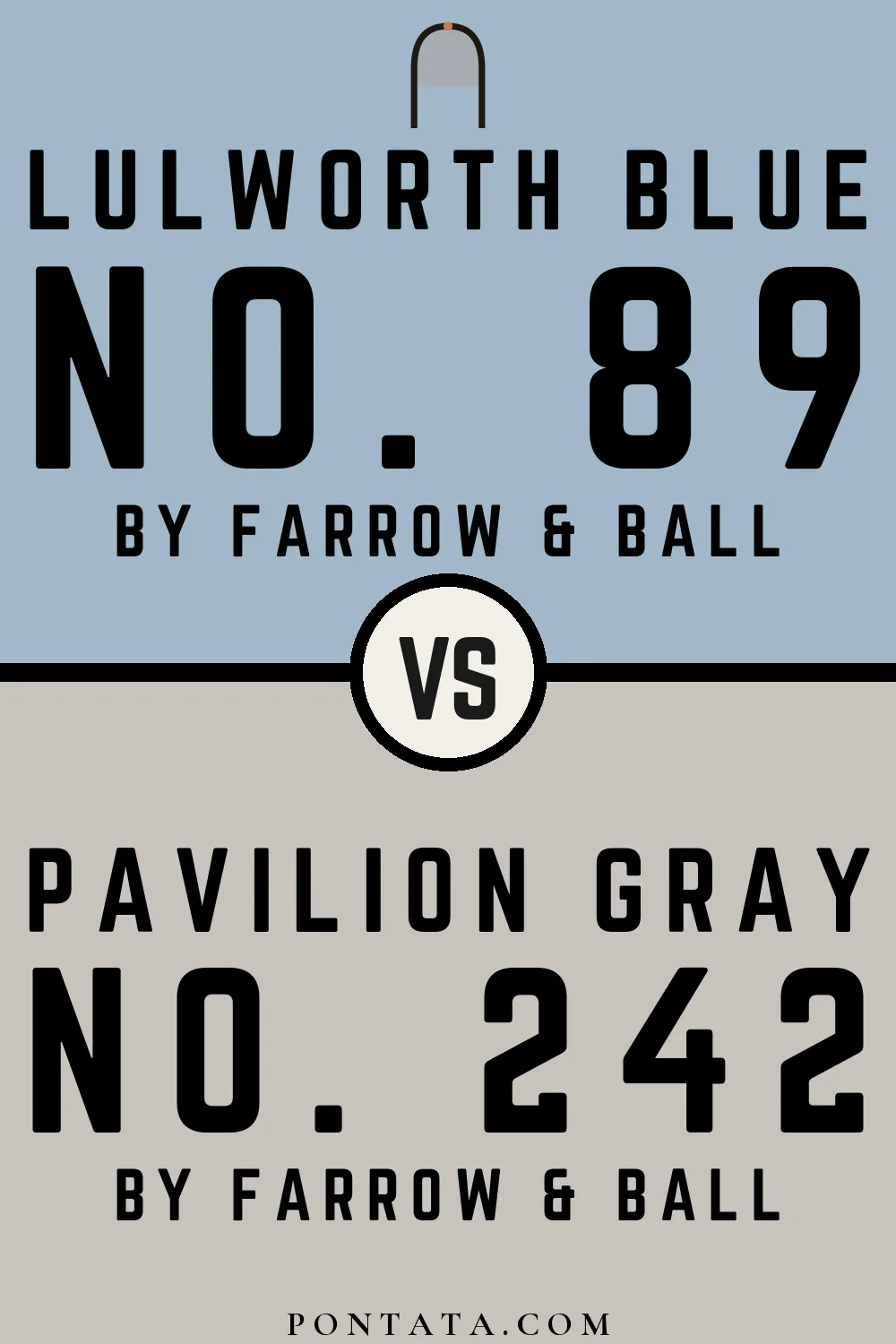
Lulworth Blue vs Pavilion Gray
Both are Farrow & Ball colors. Lulworth Blue reads as blue, while Pavilion Gray reads as greige-grey — two distinct hue families, not close cousins. At LRV 55 vs 45, Pavilion Gray will read as the brighter of the two — a 10-point gap that matters most in north-facing or low-light rooms. The tonal difference — Lulworth Blue's cool character against Pavilion Gray's warm — becomes most visible against white trim or in morning light. At ΔE 17.3, these are genuinely distinct colors — a strong contrast if used together, or a meaningful choice between two different directions. Below you'll find 5 real-room photo comparisons where both colors appear side by side, plus 5 simulated room previews.
Lulworth Blue vs Pavilion Gray in Real Spaces
5 real rooms side by side. Seeing Lulworth Blue and Pavilion Gray in actual rooms makes the difference concrete; browse the spaces below to get a feel for how each color lives on a wall.
Living Room
Living rooms test a color across a full range of conditions — morning sun, afternoon shade, and evening lamp light all shift how both of these read. Pavilion Gray returns significantly more light to the room — in a smaller or darker space, that difference in perceived brightness is hard to miss.


Bedroom
Bedroom walls are often seen under warm artificial light, a context that shifts both colors from how they look on a chip. The LRV gap is large enough that Pavilion Gray will make the room feel meaningfully brighter than Lulworth Blue would.


Bathroom
Bathrooms amplify color — the enclosed space and reflective surfaces make what reads subtle elsewhere feel more present here. The LRV gap is large enough that Pavilion Gray will make the room feel meaningfully brighter than Lulworth Blue would.


Front Door
Front doors are seen in isolation against the rest of the facade, which makes them a high-stakes surface where even subtle differences matter. Pavilion Gray returns significantly more light to the room — in a smaller or darker space, that difference in perceived brightness is hard to miss.


Kitchen Cabinets
On cabinetry, undertone and temperature become more pronounced against countertops and hardware. The LRV gap is large enough that Pavilion Gray will make the room feel meaningfully brighter than Lulworth Blue would.

Color Details
Lulworth Blue vs Pavilion Gray Simulated Comparison
5 simulated room previews — drag the slider on each to see Lulworth Blue on one side and Pavilion Gray on the other.


Digital color is approximate. These simulations are generated from the manufacturer's hex values and overlaid on grayscale room photos — your screen's calibration, brightness, and viewing angle all affect how they render. Before committing to either color, test physical samples in your own space under the light you actually live with.
More Lulworth Blue comparisons
See how Lulworth Blue stacks up against other well-photographed colors across different brands and tones.


Ammonite reflects far more light (LRV 69 vs 45), opening up a space where Lulworth Blue encloses it.


Purbeck Stone reads slightly lighter (LRV 52 vs 45), a gap that shows most in low-lit rooms.


Their light reflectance is nearly identical (LRV 45 vs 44), so neither reads brighter in a room.


At LRV 68 vs 45, Skimming Stone is decisively the brighter choice.