Match California Redwood

Benjamin Moore California Redwood is a deep, low-reflectance shade, warm in character with an LRV of 15. The matches below are ranked by ΔE, a perceptual color-difference score.

View full California Redwood color page →
California Redwood
Benjamin Moore
California Redwood
1190#985949LRV 15Warm

Closest matches across every brand

One match per brand, ranked by ΔE — a perceptual color difference score calculated from Lab color space values. Lower is closer. Click any card to compare side by side in simulated rooms.

California Redwood
Brickyard Red
California Redwood
Benjamin Moore
Brickyard Red
CW-325 · LRV 15
Benjamin Moore
California Redwood
1190 · LRV 15

With LRVs of 15 and 15, the two reflect almost the same amount of light. At ΔE 0.0 you'd need them side by side to tell them apart.

View color →ΔE 0.0 — Imperceptible
California Redwood
California Redwood
Baked Clay
Baked Clay
California Redwood vs Baked Clay
Benjamin Moore
California Redwood
1190 · LRV 15
Cloverdale Paint
Baked Clay
EX027 · LRV 15

With LRVs of 15 and 15, the two reflect almost the same amount of light. At ΔE 1.5 you'd need them side by side to tell them apart.

View color →ΔE 1.5 — Subtle
California Redwood
California Redwood
Terrakotta
California Redwood vs Terrakotta
Benjamin Moore
California Redwood
1190 · LRV 15
Tikkurila
Terrakotta
N405 · LRV 14

Their light reflectance is nearly identical (LRV 15 vs 14), so neither reads brighter in a room. A ΔE of 2.4 means the difference barely reads in a finished room.

View color →ΔE 2.4 — Subtle
California Redwood
California Redwood
Heat
Heat
California Redwood vs Heat
Benjamin Moore
California Redwood
1190 · LRV 15
Jotun
Heat
2994 · LRV 16

With LRVs of 16 and 15, the two reflect almost the same amount of light. At ΔE 3.1 they're clearly different, yet close enough to share a room.

View color →ΔE 3.1 — Noticeable
California Redwood
California Redwood
Picture Gallery Red
Picture Gallery Red
California Redwood vs Picture Gallery Red
Benjamin Moore
California Redwood
1190 · LRV 15

Their light reflectance is nearly identical (LRV 16 vs 15), so neither reads brighter in a room. The ΔE 3.9 gap is real but not dramatic — distinct as a choice, harmonious together.

View color →ΔE 3.9 — Noticeable
California Redwood
California Redwood
Rich Clay
California Redwood vs Rich Clay
Benjamin Moore
California Redwood
1190 · LRV 15
PPG
Rich Clay
PPG16-31 · LRV 16

Their light reflectance is nearly identical (LRV 16 vs 15), so neither reads brighter in a room. The ΔE 3.9 gap is real but not dramatic — distinct as a choice, harmonious together.

View color →ΔE 3.9 — Noticeable
California Redwood
California Redwood
Rookwood Terra Cotta
California Redwood vs Rookwood Terra Cotta
Benjamin Moore
California Redwood
1190 · LRV 15
Sherwin-Williams
Rookwood Terra Cotta
2803 · LRV 14

Their light reflectance is nearly identical (LRV 15 vs 14), so neither reads brighter in a room. The ΔE 4.7 gap is real but not dramatic — distinct as a choice, harmonious together.

View color →ΔE 4.7 — Noticeable
True Copper
True Copper
California Redwood
California Redwood
True Copper vs California Redwood
Behr
True Copper
S180-7 · LRV 13
Benjamin Moore
California Redwood
1190 · LRV 15

Their light reflectance is nearly identical (LRV 15 vs 13), so neither reads brighter in a room. The ΔE 5.1 gap is real but not dramatic — distinct as a choice, harmonious together.

View color →ΔE 5.1 — Noticeable
California Redwood
California Redwood
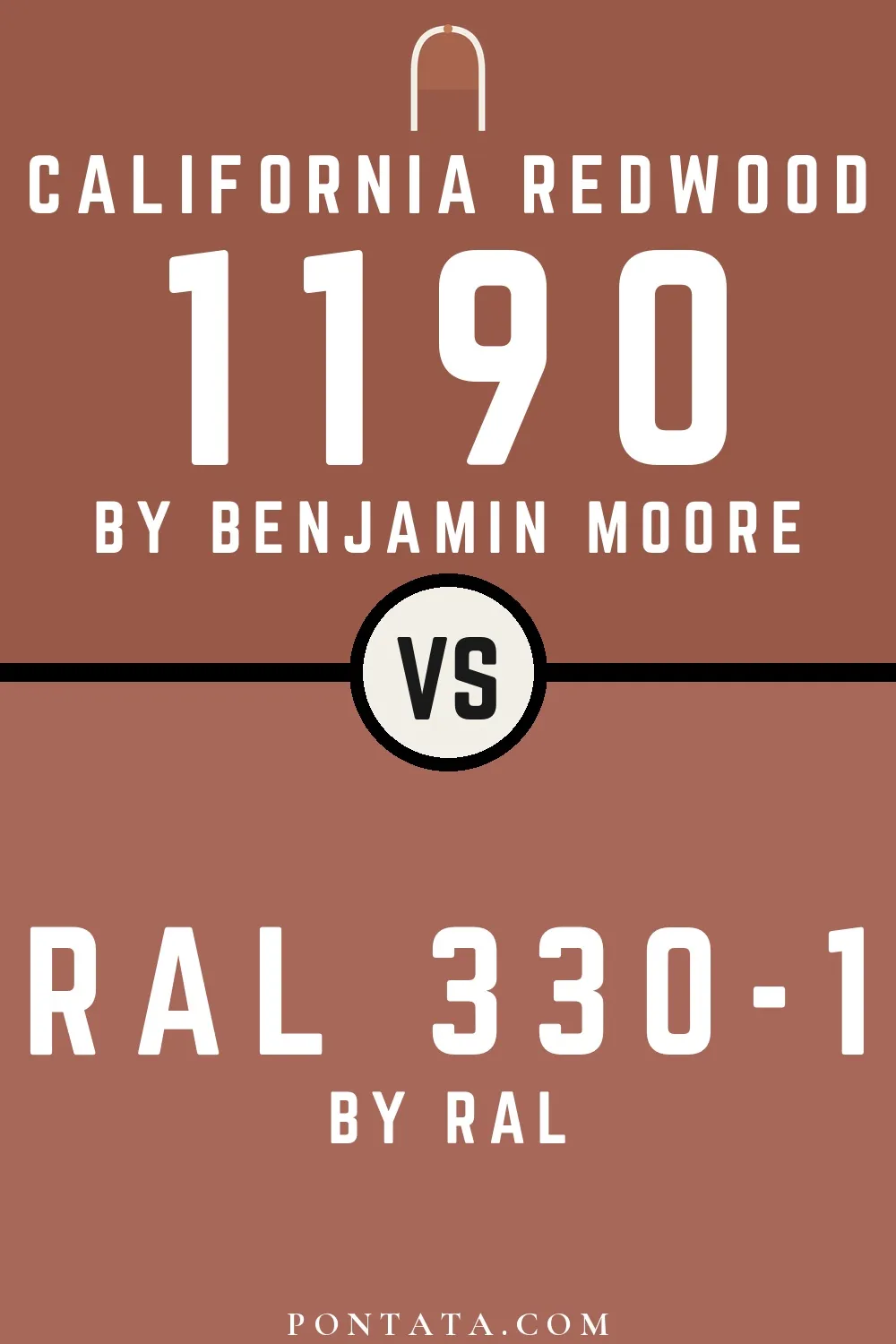
RAL 330-1
RAL 330-1
California Redwood vs RAL 330-1
Benjamin Moore
California Redwood
1190 · LRV 15
RAL EffectEffect
RAL 330-1
RAL 330-1 · LRV 19

A 4-point LRV gap (19 vs 15) makes RAL 330-1 the marginally brighter of the two. The ΔE 6.1 gap is real but not dramatic — distinct as a choice, harmonious together.

View color →ΔE 6.1 — Noticeable
California Redwood
California Redwood
Muscovado
Benjamin Moore
California Redwood
1190 · LRV 15
Little Greene
Muscovado
343 · LRV 12

California Redwood reads slightly lighter (LRV 15 vs 12), a gap that shows most in low-lit rooms. At ΔE 8.0 they're clearly different, yet close enough to share a room.

View color →ΔE 8.0 — Noticeable
California Redwood
California Redwood
Copper brown
Copper brown
California Redwood vs Copper brown
Benjamin Moore
California Redwood
1190 · LRV 15
RAL ClassicClassic
Copper brown
RAL 8004 · LRV 14

Their light reflectance is nearly identical (LRV 15 vs 14), so neither reads brighter in a room. The ΔE 9.1 gap is real but not dramatic — distinct as a choice, harmonious together.

View color →ΔE 9.1 — Noticeable
California Redwood
California Redwood
Auburn Embers
Auburn Embers
California Redwood vs Auburn Embers
Benjamin Moore
California Redwood
1190 · LRV 15
Dulux
Auburn Embers
04YR 18/324 · LRV 18

With LRVs of 18 and 15, the two reflect almost the same amount of light. At ΔE 9.8 they're clearly different, yet close enough to share a room.

View color →ΔE 9.8 — Noticeable
California Redwood
California Redwood
S 5040-Y80R
S 5040-Y80R
California Redwood vs S 5040-Y80R
Benjamin Moore
California Redwood
1190 · LRV 15
NCS
S 5040-Y80R
S 5040-Y80R · LRV 7

A 8-point LRV gap (15 vs 7) makes California Redwood the marginally brighter of the two. A ΔE of 14.6 puts them firmly in different territory — a strong contrast if combined.

View color →ΔE 14.6 — Distinct
California Redwood
California Redwood
Muddy Mississippi
California Redwood vs Muddy Mississippi
Benjamin Moore
California Redwood
1190 · LRV 15
Valspar
Muddy Mississippi
3004-9A · LRV 13

With LRVs of 15 and 13, the two reflect almost the same amount of light. At ΔE 15.0 these are two genuinely different directions, not variations on a theme.

View color →ΔE 15.0 — Distinct