
Artifact
At first glance, Artifact belongs to the yellow family; in a room, light and context can make it far more elusive. Its beige and greige classifications hint at the directions it may take as daylight, lamps and neighboring colors move around it. Because screens flatten both light and texture, sample the paint beside the finishes that will ultimately surround it.
Hex
#9A815ELRV
23.38
Artifact's Color Strip
Artifact is the sixth shade on this 7-color strip, sitting between Burlap and Mossy Gold. The strip spans from Netsuke at the lightest end to Mossy Gold at the deepest. Strip 208 puts these related shades in sequence, making it simple to find the tone that suits your room.


Artifact in Rooms
Follow Artifact from one space to another and watch how light, scale and surrounding materials reshape its character. 10 generated visualizations explore how the color might shape a finished room.
1 Bathroom Photo
Against tile, stone, glass, timber and metal fixtures, Artifact (6138) may feel quieter, sharper or more atmospheric than the digital swatch alone. An LRV of 23.4 lets the color hold its identity across both brighter and more shaded parts of the room.
Artifact — wabi-sabi bathroom
@mybudgetrecipes
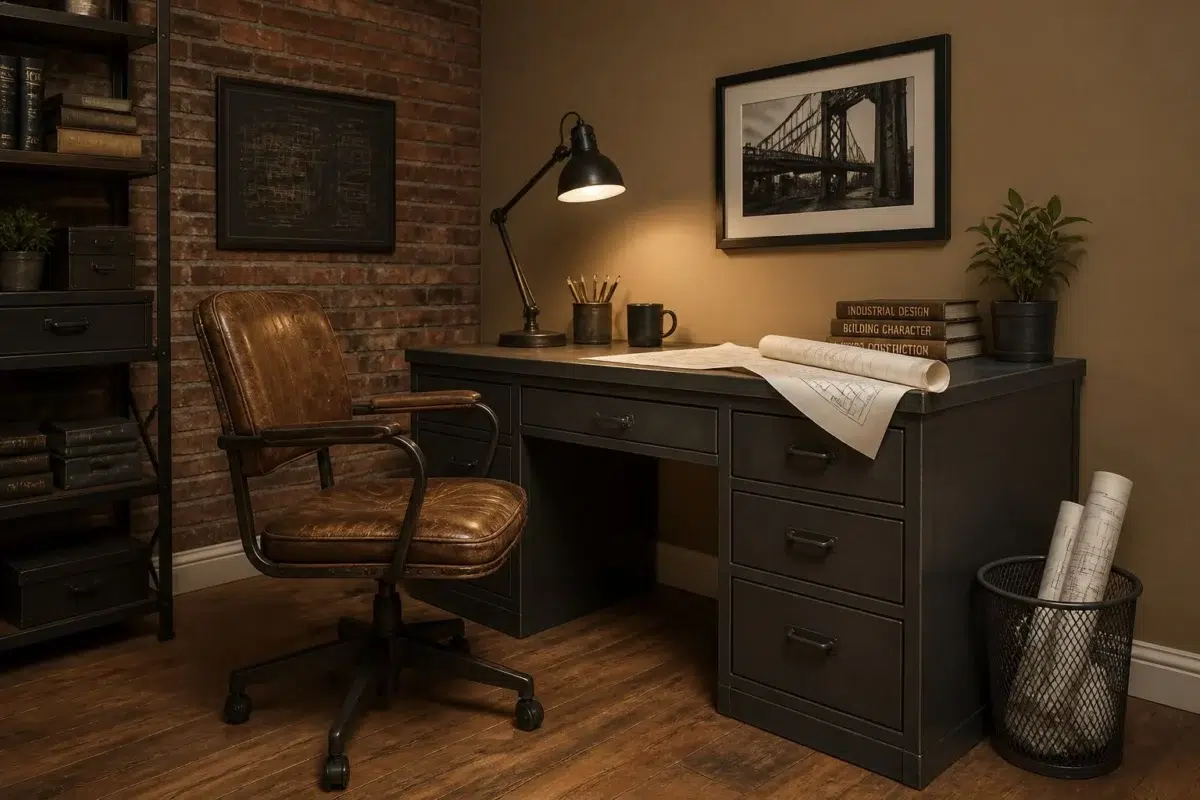
1 Home Office Photo
Artifact (6138) moves through 1 home office image without becoming a fixed prescription for the room. Its warm classification can feel inviting beside tactile, natural materials.

Sherwin-Williams Artifact in a industrial home office
@mybudgetrecipes
1 Bedroom Photo
Artifact (6138) offers a starting mood rather than a finished formula: Its warm classification can feel inviting beside tactile, natural materials. Test it under gentle morning light and low evening lamps.

A moody bedroom painted in Artifact
@mybudgetrecipes
1 Dining Room Photo
Artifact (6138) offers a starting mood rather than a finished formula: Its warm classification can feel inviting beside tactile, natural materials. Test it under natural light, candles and pendant lighting.

Artifact paint in a traditional dining room
@mybudgetrecipes
1 Front Door Photo
The 1 front door image turn a yellow swatch into something more spatial and expressive. Its muted saturation softens the color’s edges, making texture and shadow part of the composition.

minimalist front door featuring Artifact by Sherwin-Williams
@mybudgetrecipes
1 Living Room Photo
These 1 living room image show how Artifact (6138) can sit beside upholstery, timber, art and metal accents. The beige, greige hue classifications suggest the subtle directions the color may take as the room changes.

A organic modern living room painted in Artifact
@mybudgetrecipes
1 Patio Photo
Artifact (6138) moves through 1 patio image without becoming a fixed prescription for the room. Its warm classification can feel inviting beside tactile, natural materials.

wabi-sabi patio featuring Artifact by Sherwin-Williams
@mybudgetrecipes
1 Mudroom Photo
The beige, greige hue classifications suggest the subtle directions the color may take as the room changes. In this setting, let doorway light and the softer illumination of an internal passage and flooring, storage, timber, baskets and hardware guide the final sample decision.

Artifact paint in a traditional mudroom
@mybudgetrecipes
1 Kitchen Photo
Artifact (6138) moves through 1 kitchen image without becoming a fixed prescription for the room. Its warm classification can feel inviting beside tactile, natural materials.

Artifact — contemporary kitchen
@mybudgetrecipes
1 House Photo
The 1 house image turn a yellow swatch into something more spatial and expressive. Its muted saturation softens the color’s edges, making texture and shadow part of the composition.

Artifact color — rustic modern house inspiration
@mybudgetrecipes
Expert Perspectives
Articles and features from across our network of home and design sites.
Coordinating Colors


With LRVs of 23 and 23, the two reflect almost the same amount of light.
Trim Color
Similar Colors


With LRVs of 23 and 22, the two reflect almost the same amount of light.


A 3-point LRV gap (27 vs 23) makes Tangled Twine the marginally brighter of the two.

Their light reflectance is nearly identical (LRV 25 vs 23), so neither reads brighter in a room.


Their light reflectance is nearly identical (LRV 24 vs 23), so neither reads brighter in a room.


With LRVs of 23 and 23, the two reflect almost the same amount of light.


With LRVs of 23 and 22, the two reflect almost the same amount of light.

Their light reflectance is nearly identical (LRV 23 vs 22), so neither reads brighter in a room.
Complementary Colors


Artifact reads slightly lighter (LRV 23 vs 11), a gap that shows most in low-lit rooms.


Artifact reflects far more light (LRV 23 vs 7), opening up a space where Sea Mariner encloses it.


Starry Night reflects far more light (LRV 69 vs 23), opening up a space where Artifact encloses it.


A 3-point LRV gap (23 vs 20) makes Artifact the marginally brighter of the two.


With LRVs of 23 and 22, the two reflect almost the same amount of light.


A 4-point LRV gap (28 vs 23) makes Dusty Heather the marginally brighter of the two.
Lighter Colors

A 5-point LRV gap (28 vs 23) makes Sandy Ridge the marginally brighter of the two.


Stone Lion reflects far more light (LRV 38 vs 23), opening up a space where Artifact encloses it.

At LRV 38 vs 23, Prairie Grass is decisively the brighter choice.


Their light reflectance is nearly identical (LRV 26 vs 23), so neither reads brighter in a room.

Darker Colors


At LRV 23 vs 10, Artifact is decisively the brighter choice.

A 4-point LRV gap (23 vs 19) makes Artifact the marginally brighter of the two.

Artifact reads slightly lighter (LRV 23 vs 18), a gap that shows most in low-lit rooms.


A 4-point LRV gap (23 vs 19) makes Artifact the marginally brighter of the two.
Color Codes
Manufacturer description
Evoke a sense of journey and discovery with this warm neutral and its cool khaki undertones. Consider in a living room strewn with the mementos of your travels.