
Chinese Red
Chinese Red is a Red paint color from Sherwin-Williams, but its character reaches beyond a single label. Its pink and red classifications hint at the directions it may take as daylight, lamps and neighboring colors move around it. Treat the digital swatch as an opening note, then watch a physical sample from morning light through evening lamps.
Hex
#9E3E33LRV
10.96
Chinese Red in Rooms
Follow Chinese Red from one space to another and watch how light, scale and surrounding materials reshape its character. 10 generated visualizations explore how the color might shape a finished room.
1 Front Door Photo
Chinese Red (0057) can change noticeably under direct sun, porch shade and evening exterior light. Sample it beside the finishes that will remain in the room.
stylish front door featuring Chinese Red by Sherwin-Williams
@mybudgetrecipes
1 Bedroom Photo
Chinese Red (0057) can change noticeably under gentle morning light and low evening lamps. Sample it beside the finishes that will remain in the room.

A art deco bedroom painted in Chinese Red
@mybudgetrecipes
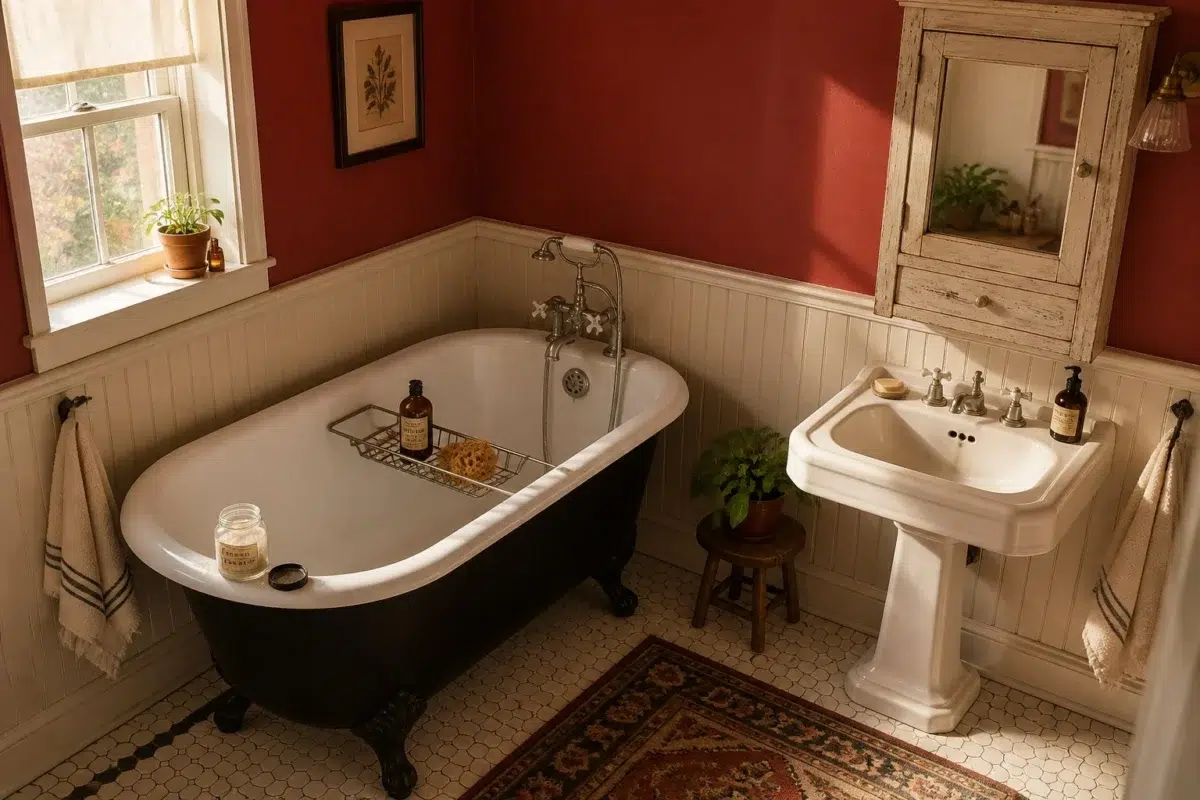
1 Bathroom Photo
Chinese Red (0057) moves through 1 bathroom image without becoming a fixed prescription for the room. Its warm classification can feel inviting beside tactile, natural materials.

Chinese Red — vintage bathroom
@mybudgetrecipes
1 Home Office Photo
The pink, red hue classifications suggest the subtle directions the color may take as the room changes. In this setting, let daylight beside desk lamps and screen glow and wood, paper, shelving and upholstered seating guide the final sample decision.

Sherwin-Williams Chinese Red in a art deco home office
@mybudgetrecipes
1 Dining Room Photo
The pink, red hue classifications suggest the subtle directions the color may take as the room changes. In this setting, let natural light, candles and pendant lighting and timber, table linen, glass and artwork guide the final sample decision.

Chinese Red paint in a contemporary dining room
@mybudgetrecipes
1 Mudroom Photo
Against flooring, storage, timber, baskets and hardware, Chinese Red (0057) may feel quieter, sharper or more atmospheric than the digital swatch alone. With an LRV of 11.0, it carries enough visual weight to make light, trim and texture feel especially deliberate.

Chinese Red paint in a earthy mudroom
@mybudgetrecipes
1 Patio Photo
1 patio image trace Chinese Red (0057) through the broad shift from bright afternoon to dusk. The pink, red hue classifications suggest the subtle directions the color may take as the room changes.

boho patio featuring Chinese Red by Sherwin-Williams
@mybudgetrecipes
1 House Photo
The façade’s movement through sun, shade and season can draw different notes from Chinese Red (0057). The pink, red hue classifications suggest the subtle directions the color may take as the room changes.

Chinese Red color — scandinavian house inspiration
@mybudgetrecipes
1 Kitchen Photo
These 1 kitchen image show how Chinese Red (0057) can sit beside stone, timber, tile and metal finishes. The pink, red hue classifications suggest the subtle directions the color may take as the room changes.

Chinese Red — earthy kitchen
@mybudgetrecipes
1 Living Room Photo
1 living room image trace Chinese Red (0057) through the room’s shift from daytime energy to evening calm. The pink, red hue classifications suggest the subtle directions the color may take as the room changes.

A industrial living room painted in Chinese Red
@mybudgetrecipes
Expert Perspectives
Articles and features from across our network of home and design sites.
Coordinating Colors


Downy reflects far more light (LRV 81 vs 11), opening up a space where Chinese Red encloses it.


At LRV 51 vs 11, Shiitake is decisively the brighter choice.
Similar Colors


Their light reflectance is nearly identical (LRV 11 vs 11), so neither reads brighter in a room.

Their light reflectance is nearly identical (LRV 11 vs 11), so neither reads brighter in a room.


Their light reflectance is nearly identical (LRV 11 vs 10), so neither reads brighter in a room.


With LRVs of 11 and 10, the two reflect almost the same amount of light.


With LRVs of 11 and 9, the two reflect almost the same amount of light.


With LRVs of 12 and 11, the two reflect almost the same amount of light.


Their light reflectance is nearly identical (LRV 12 vs 11), so neither reads brighter in a room.

Their light reflectance is nearly identical (LRV 11 vs 9), so neither reads brighter in a room.


With LRVs of 11 and 11, the two reflect almost the same amount of light.


With LRVs of 11 and 10, the two reflect almost the same amount of light.
Complementary Colors


At LRV 61 vs 11, Tradewind is decisively the brighter choice.


Their light reflectance is nearly identical (LRV 11 vs 10), so neither reads brighter in a room.


Stargazer reads slightly lighter (LRV 17 vs 11), a gap that shows most in low-lit rooms.


A 11-point LRV gap (22 vs 11) makes Blustery Sky the marginally brighter of the two.


Teal Stencil reads slightly lighter (LRV 19 vs 11), a gap that shows most in low-lit rooms.


Interesting Aqua reflects far more light (LRV 41 vs 11), opening up a space where Chinese Red encloses it.


At LRV 41 vs 11, Aqua-Sphere is decisively the brighter choice.
Lighter Colors

A 3-point LRV gap (14 vs 11) makes Red Tomato the marginally brighter of the two.


Peppery reads slightly lighter (LRV 17 vs 11), a gap that shows most in low-lit rooms.


A 5-point LRV gap (16 vs 11) makes Jalapeño the marginally brighter of the two.


Ablaze reads slightly lighter (LRV 16 vs 11), a gap that shows most in low-lit rooms.


A 4-point LRV gap (15 vs 11) makes Habanero Chile the marginally brighter of the two.
Darker Colors


A 3-point LRV gap (11 vs 8) makes Chinese Red the marginally brighter of the two.


A 4-point LRV gap (11 vs 7) makes Chinese Red the marginally brighter of the two.
Their light reflectance is nearly identical (LRV 11 vs 10), so neither reads brighter in a room.


A 5-point LRV gap (11 vs 6) makes Chinese Red the marginally brighter of the two.
With LRVs of 11 and 10, the two reflect almost the same amount of light.
Color Codes
Manufacturer description
A timeless hue from the Jazz Age, this deep, saturated red fills a room with bold, dramatic energy and worldly sophistication.
Attributed to Sherwin-Williams catalog data.