
Cavern Clay
Sherwin-Williams Cavern Clay (7701) carries the measured structure of its color data and the less predictable beauty of paint in a finished space. Its warm classification can bring a gentle glow to the color, particularly beside natural wood and softer whites. Treat the digital swatch as an opening note, then watch a physical sample from morning light through evening lamps.
Hex
#AC6B53LRV
19.94
Cavern Clay's Color Strip
Cavern Clay is the sixth shade on this 7-color strip, sitting between Spiced Cider and Copper Wire. The strip spans from Ligonier Tan at the lightest end to Copper Wire at the deepest. As part of strip 290, these colors are curated to work together — helpful when you're deciding how light or deep to go.


Cavern Clay in Rooms
Follow Cavern Clay from one space to another and watch how light, scale and surrounding materials reshape its character. 32 sourced room photos sit alongside 7 generated visualizations.
5 Bathroom Photos
5 bathroom images place Cavern Clay (7701) in a compact setting where tile, fixtures and color sit close together. An LRV of 19.9 lets the color hold its identity across both brighter and more shaded parts of the room.
Bathroom walls in warm Cavern Clay create an earthy, spa-like retreat.
@mybudgetrecipes

Bathroom vanity painted in Cavern Clay adds natural warmth to the space.
@home.made.homes

Bathroom cabinetry in Cavern Clay pairs beautifully with marble countertops and fixtures.
@chadesslingerdesign

Ceiling and walls in Cavern Clay envelop the bathroom in earthy comfort.
@chadesslingerdesign

Vanity cabinet in Cavern Clay grounds the bathroom with natural, understated elegance.
@chadesslingerdesign
10 Bedroom Photos
Viewed across 10 bedroom images in a room designed around rest, softness and retreat, Cavern Clay (7701) reveals how much color depends on scale, surface and shadow. An LRV of 19.9 lets the color hold its identity across both brighter and more shaded parts of the room.

Soft bedding contrasts beautifully against Cavern Clay accent walls.
@mybudgetrecipes
1 Front Door Photo
In a small architectural moment with an outsized first impression, the most interesting quality of Cavern Clay (7701) may be the way it responds to hardware, glazing, masonry, timber and surrounding trim. The beige, pink hue classifications suggest the subtle directions the color may take as the room changes.

The front door painted in Cavern Clay makes a welcoming first impression.
@mybudgetrecipes
1 Home Office Photo
1 generated visualization explores how the color might shape the finished space. Together they show Cavern Clay (7701) as inspiration rather than a promise of an identical result.

Desk and shelving stand out against Cavern Clay walls in this workspace.
@mybudgetrecipes
1 House Photo
Cavern Clay (7701) brings its orange character into an exterior viewed across distance, weather and the changing sky. Its midtone saturation keeps the color expressive without letting it dominate every surface around it.

Exterior siding in Cavern Clay gives the house a modern, grounded appearance.
@mybudgetrecipes
2 Kitchen Photos
Its place within 2018 Connectivity and 2019 Wanderer hints at the range of palettes it can inhabit. In this setting, let daylight, task lighting and evening pendants and stone, timber, tile and metal finishes guide the final sample decision.

Kitchen cabinetry pairs warmly with Cavern Clay wall color.
@mybudgetrecipes

Kitchen cabinetry in Cavern Clay provides a sophisticated, earthy foundation for cooking.
@zukeminded
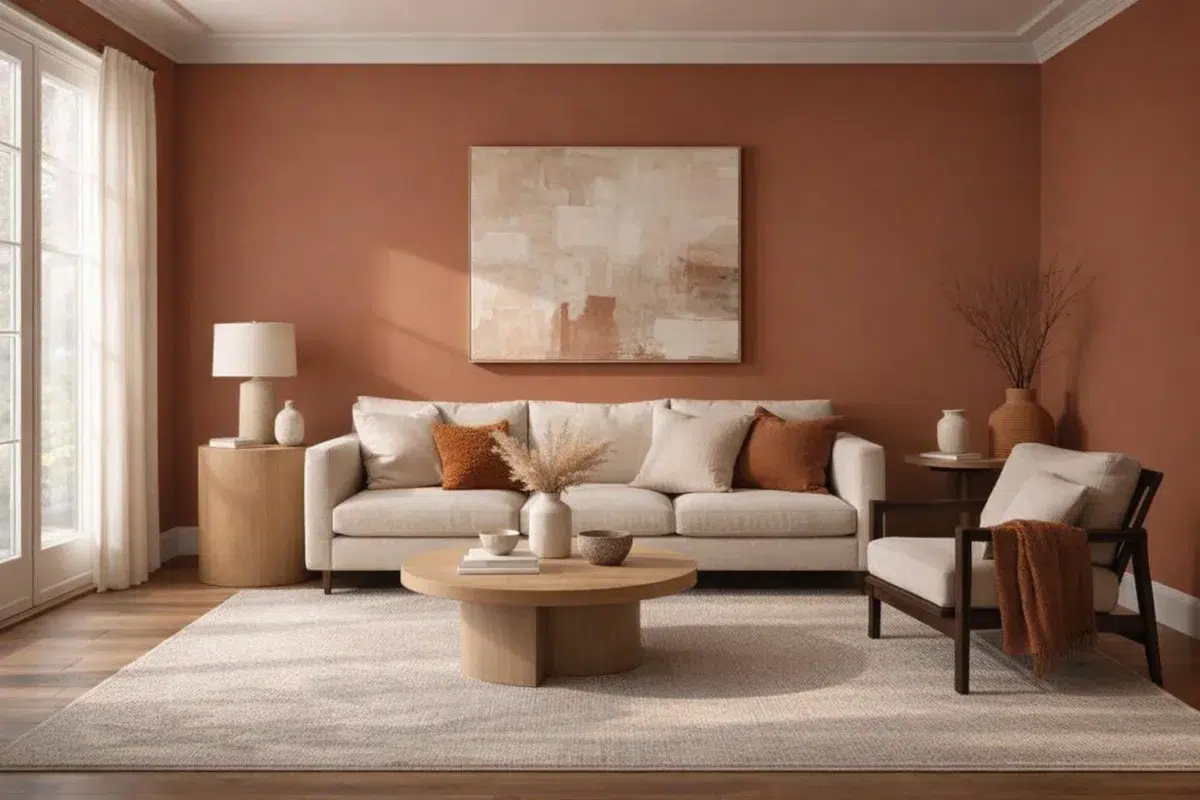
13 Living Room Photos
13 living room images place Cavern Clay (7701) in a space shaped by conversation, quiet evenings and changing daylight. An LRV of 19.9 lets the color hold its identity across both brighter and more shaded parts of the room.

@mybudgetrecipes
6 Misc Photos
Viewed across 6 misc images in an assortment of spaces that reveals the color outside a single design formula, Cavern Clay (7701) reveals how much color depends on scale, surface and shadow. An LRV of 19.9 lets the color hold its identity across both brighter and more shaded parts of the room.

Painted storage boxes in Cavern Clay add functional style to any room.
@christina_we3dwellings
Expert Perspectives
Articles and features from across our network of home and design sites.
Coordinating Colors


Creamy reflects far more light (LRV 81 vs 20), opening up a space where Cavern Clay encloses it.

Slate Violet reads slightly lighter (LRV 29 vs 20), a gap that shows most in low-lit rooms.

Ligonier Tan reflects far more light (LRV 47 vs 20), opening up a space where Cavern Clay encloses it.
Trim Color
Creamy reflects far more light (LRV 81 vs 20), opening up a space where Cavern Clay encloses it.
Similar Colors

Their light reflectance is nearly identical (LRV 20 vs 19), so neither reads brighter in a room.

With LRVs of 20 and 20, the two reflect almost the same amount of light.


Their light reflectance is nearly identical (LRV 20 vs 18), so neither reads brighter in a room.


Their light reflectance is nearly identical (LRV 22 vs 20), so neither reads brighter in a room.


With LRVs of 20 and 19, the two reflect almost the same amount of light.


A 4-point LRV gap (23 vs 20) makes Spiced Cider the marginally brighter of the two.


Rojo Dust reads slightly lighter (LRV 23 vs 20), a gap that shows most in low-lit rooms.


With LRVs of 20 and 19, the two reflect almost the same amount of light.


Caribbean Coral reads slightly lighter (LRV 25 vs 20), a gap that shows most in low-lit rooms.


With LRVs of 20 and 17, the two reflect almost the same amount of light.
Complementary Colors


At LRV 53 vs 20, Niebla Azul is decisively the brighter choice.


Silver Lake reflects far more light (LRV 53 vs 20), opening up a space where Cavern Clay encloses it.


Cavern Clay reads slightly lighter (LRV 20 vs 16), a gap that shows most in low-lit rooms.


Glass Bead reflects far more light (LRV 77 vs 20), opening up a space where Cavern Clay encloses it.


A 9-point LRV gap (29 vs 20) makes Morning at Sea the marginally brighter of the two.


At LRV 20 vs 6, Cavern Clay is decisively the brighter choice.


At LRV 34 vs 20, Debonair is decisively the brighter choice.
Lighter Colors


Cabbage Rose reflects far more light (LRV 39 vs 20), opening up a space where Cavern Clay encloses it.


At LRV 43 vs 20, Pinky Beige is decisively the brighter choice.
Their light reflectance is nearly identical (LRV 22 vs 20), so neither reads brighter in a room.


At LRV 32 vs 20, Roycroft Rose is decisively the brighter choice.
Rojo Dust reads slightly lighter (LRV 23 vs 20), a gap that shows most in low-lit rooms.
Darker Colors
Their light reflectance is nearly identical (LRV 20 vs 18), so neither reads brighter in a room.
Their light reflectance is nearly identical (LRV 20 vs 19), so neither reads brighter in a room.


Cavern Clay reads slightly lighter (LRV 20 vs 14), a gap that shows most in low-lit rooms.


Cavern Clay reflects far more light (LRV 20 vs 7), opening up a space where Aurora Brown encloses it.
Color Codes
Manufacturer description
This robust, reddish orange midtone provides a rich brilliant depth on any wall. Create a warmhearted, welcoming atmosphere in your kitchen or bathroom.
Attributed to Sherwin-Williams catalog data.